
By Teresa Garciduenas 2026
A Christian Review of “Understanding the Great Awakening” by Kelly Ohlson
When I began reading “Understanding the Great Awakening” by Kelly Ohlson, I expected a book about spiritual awakening—perhaps an examination of the Church, the condition of Christianity today, and whether believers are truly measuring themselves against the Word of God.
Instead, I encountered something very different. The book weaves biblical themes together with conspiracy theories, political claims, alleged secret histories, and claims of prophetic insight. Some of the subjects Ohlson discusses concern genuine biblical warnings about evil and deception. That is precisely why Christians must be careful. Something containing elements of truth is not necessarily entirely true.
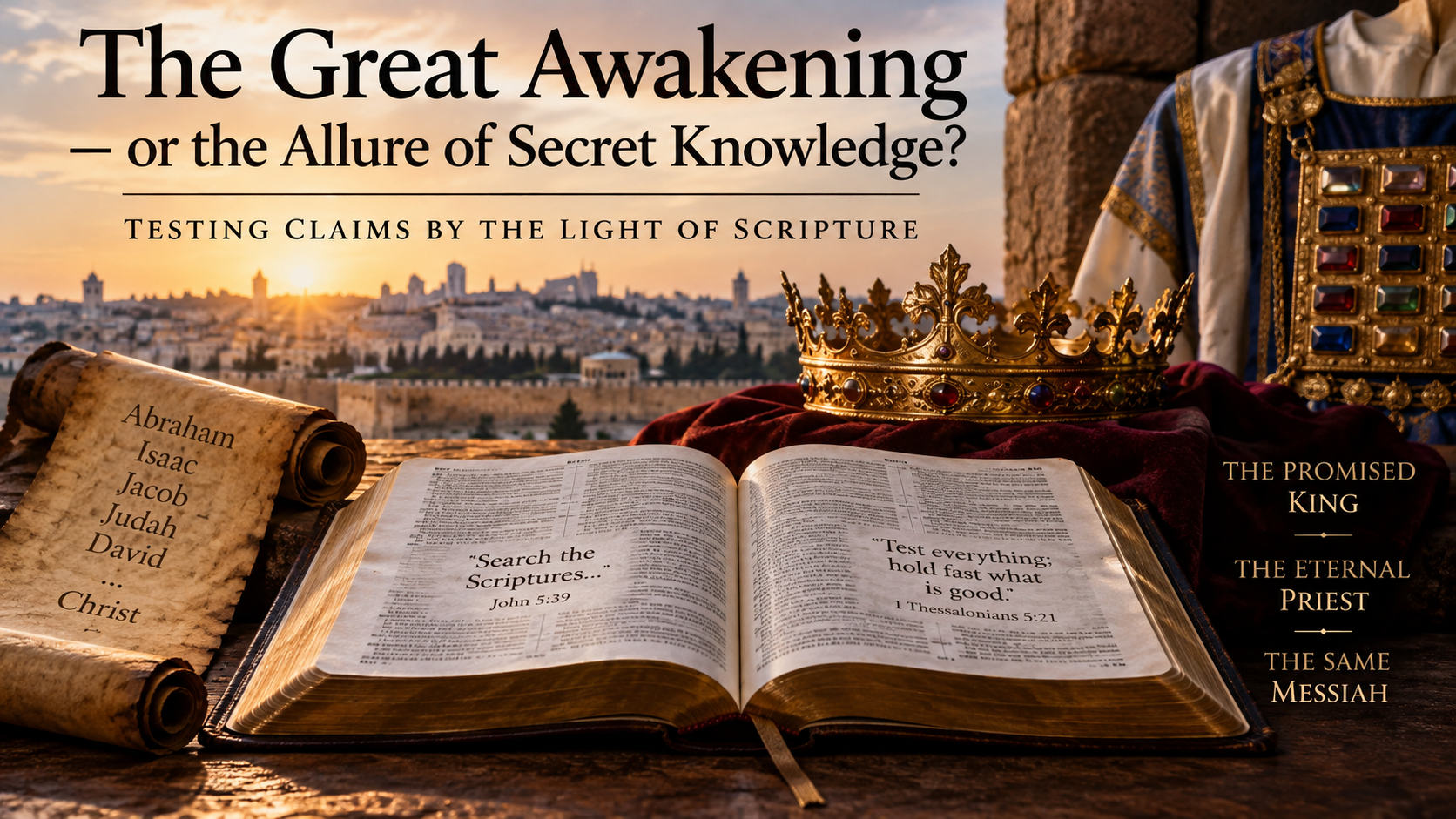
As Christians, we are commanded to test what we hear: “Test everything; hold fast what is good” (1 Thessalonians 5:21, ESV). That is the standard I believe should be applied to this book.
God Speaks—but That Does Not Make Someone a Prophet
I believe God communicates with His people. Christians have testimonies. We experience conviction, guidance, answered prayer, and moments in our lives when God’s direction becomes unmistakably clear. But experiencing God’s communication does not automatically make someone a prophet.
Throughout Scripture, prophets were called by God for a particular purpose. They did not simply assume the title because they had received a dream, experienced something supernatural, or believed God had spoken personally to them.
More importantly, the message of someone claiming to speak for God must be tested against what God has already revealed. Deuteronomy 13:1–5 warns that even if a sign occurs, God’s people must reject a prophet whose message leads them away from the LORD. Deuteronomy 18:20–22 warns against speaking presumptuously in God’s name.
Jesus warned that “many false prophets will arise and lead many astray” (Matthew 24:11, ESV). John likewise tells Christians, “Beloved, do not believe every spirit, but test the spirits to see whether they are from God” (1 John 4:1, ESV).
Therefore, the question isn’t simply, “Did this person experience something supernatural?” The question is: Does the message align with Scripture? A genuine message from God will not require us to abandon God’s revealed truth for a contradictory message, another gospel, or supposedly superior secret knowledge. Paul even tells us that if an angel from heaven proclaimed a gospel contrary to the one already received, it was to be rejected (Galatians 1:8).
We Were Already Warned
Another problem I encountered is the presentation of information as though Christians are experiencing a new awakening to realities that have been hidden from us. But what exactly are we awakening to? That Satan exists? That evil operates in the world? That governments and rulers can become corrupt? That people deceive one another? That false teachers will infiltrate the Church? That spiritual powers oppose God?
None of this is secret knowledge. God already warned us.
Paul writes that “we do not wrestle against flesh and blood,” but against rulers, authorities, cosmic powers over this present darkness, and spiritual forces of evil (Ephesians 6:12, ESV). Scripture repeatedly warns about deception, lawlessness, false prophets, false teachers, doctrines of demons, and spiritual wickedness. Jesus begins His Olivet Discourse with the warning, “See that no one leads you astray” (Matthew 24:4, ESV).
This is why I struggle with calling the discovery of conspiracies a “Great Awakening.” Christians were never supposed to be asleep concerning evil. We were already warned. Our awakening should therefore not be an awakening to conspiracy. It should be an awakening to Christ.
The Problem of Secret Knowledge
One of my greatest concerns with this book is the impression that the reader is being given knowledge that other people do not possess. The underlying message can begin to sound like this: You have been asleep. The truth has been hidden. The world isn’t what you have been told. Now you are going to learn what is really happening.
That should immediately cause a discerning Christian to slow down. Christianity is not a religion built upon an elite group possessing secret knowledge unavailable to ordinary believers. The Gospel was proclaimed openly. Our salvation doesn’t depend upon discovering the correct conspiracy. It depends upon Jesus Christ.
There is also a powerful problem created when established facts, biblical truths, speculation, political opinions, and unsupported historical claims are woven together. Because the reader recognizes truth in some statements, he or she may unconsciously grant credibility to everything that follows. But biblical discernment doesn’t work that way. Every claim must stand on its own evidence.
The Judean and Khazar Claims
This becomes especially problematic in the book’s discussion of Judeans, Khazars, and Jewish history. Ohlson writes: “Outsiders called them Judeans, but they were not Jews. That term was not created until the 18th century.” This is historically problematic.
Judea and Judeans existed in antiquity, centuries before the eighteenth century. The terminology developed from Judah/Judea and appears in ancient historical contexts long before medieval Khazaria. The book then connects Sumer, Babylon, Canaan, Khazaria, Ashkenazim, and Judeans into what appears to be a continuous historical lineage. But these populations cannot simply be combined. [2]
There is, however, an ancient population that is extremely important when discussing the ethnic and religious complexities of Judea: the Idumeans. The Idumeans were associated with ancient Edom and were originally distinct from Israel. During the Hasmonean period, John Hyrcanus conquered Idumean territory and required its inhabitants who remained to accept circumcision and Jewish customs. Josephus records this incorporation centuries before the medieval Khazar period.
This demonstrates that Second Temple Judea was historically complicated. Some people incorporated into the Jewish population were of Idumean ancestry. Herod’s dynasty provides a famous example of Idumean ancestry within the Judean political world. But none of that demonstrates that Judeans were actually medieval Khazars.
The chronology makes such an argument impossible. Second Temple Judeans existed before Christ. Josephus wrote during the first century AD. The Khazar conversion to Judaism occurred centuries afterward. Whatever role Khazars may have played in later Jewish history, they cannot be used to explain away the existence of Jews or Judeans documented many centuries before them.
The Judean Error and the Identity of the Messiah
The historical errors concerning the Judeans are not merely an academic concern. They have theological consequences because the New Testament identifies Jesus Christ within the history and promises of Israel. If a reader accepts the claim that the Judeans of the Second Temple period were not genuinely connected to the Jewish people, that reader may begin questioning the identity of Jesus Himself. Was He truly the promised son of David? Did He fulfill the covenant promises? What becomes of the genealogies that the Gospels deliberately preserve?
Mary’s Genealogy and the House of David
The New Testament clearly presents Jesus as the promised descendant of David and a member of the tribe of Judah. Mary is the mother from whom Jesus actually took His human flesh, while Joseph was not His biological father. For that reason, Mary’s Davidic connection is important to the Christian understanding of Christ’s human descent.
Luke 1:27 describes Mary as the virgin betrothed to Joseph, who was of the house of David. Luke then announces that Mary’s Son will receive “the throne of his father David” (Luke 1:32, ESV). Paul likewise says that God’s Son was “descended from David according to the flesh” (Romans 1:3, ESV), and Hebrews explicitly states that “our Lord was descended from Judah” (Hebrews 7:14, ESV). Taken together, these passages establish the New Testament’s insistence that Jesus’ human ancestry is genuinely Davidic and Judean.
One longstanding Christian interpretation understands Matthew 1 as preserving Jesus’ legal royal genealogy through Joseph and Luke 3 as preserving His biological Davidic ancestry through Mary. On this reading, Luke’s line runs through David’s son Nathan rather than Solomon (Luke 3:31), while Matthew follows the royal line through Solomon (Matthew 1:6). Luke does not explicitly call the genealogy Mary’s, so this should be identified as an interpretation of the two Gospel genealogies rather than a statement made directly by Luke.
Mary was also related to Elizabeth, whom Luke explicitly identifies as “of the daughters of Aaron” (Luke 1:5, 36). This demonstrates a family relationship with an Aaronic household, but Scripture does not tell us precisely how that relationship was formed and does not identify Mary herself as belonging to the tribe of Levi. A family could contain connections between tribes through marriage.
This distinction strengthens rather than weakens the Melchizedekian argument. Hebrews deliberately points out that Jesus came from Judah—a tribe from which Moses appointed no priests—and then explains that Christ’s priesthood is of a different order: “You are a priest forever, after the order of Melchizedek” (Hebrews 7:14–17, ESV). Jesus is therefore the Davidic Messiah from Judah and the eternal High Priest, not because He descended from Aaron, but because God appointed Him Priest after the order of Melchizedek.
The New Testament is explicit that Jesus belongs to Judah and David. Paul writes that God’s Son was “descended from David according to the flesh” (Romans 1:3, ESV). Hebrews states, “For it is evident that our Lord was descended from Judah” (Hebrews 7:14, ESV). These declarations are central to the biblical witness concerning the Messiah. [9]
The King and Priest After the Order of Melchizedek
Under the Mosaic covenant, the Davidic kingship and Aaronic priesthood were ordinarily distinct. Kings came from Judah, while the Aaronic priesthood came from Levi. Yet Psalm 110 foretells a figure who is both exalted at God’s right hand and appointed to an everlasting priesthood: “The LORD has sworn and will not change his mind, ‘You are a priest forever after the order of Melchizedek’” (Psalm 110:4, ESV). [10]
Jesus fulfills this prophecy. Hebrews explains that His priesthood is not derived from the ordinary Levitical succession. He is appointed by God’s oath and possesses an indestructible life (Hebrews 7:16–17, 20–22). His priestly authority therefore comes from God and is not dependent upon proving a Levitical maternal genealogy. [11]
Zechariah provides another striking prophetic image: “And there shall be a priest on his throne, and the counsel of peace shall be between them both” (Zechariah 6:13, ESV). I understand this as part of the prophetic anticipation of the Messiah’s united royal and priestly ministry. Jesus is the Son of David, the Lion of the tribe of Judah, and the High Priest after the order of Melchizedek. [12]
Why This Matters to the Review
This is why Ohlson’s treatment of the Judeans requires more than a passing historical correction. When an author presents ancient Judeans as though they were not genuinely Jewish, the implications can reach directly into Christology—the biblical doctrine of who Jesus is.
The Gospels preserve genealogies for a reason. The apostles identify Jesus with Judah and David for a reason. Hebrews explains His priesthood through Melchizedek for a reason. These are not disconnected details. Together, they testify that Jesus is the promised Messiah who fulfills God’s covenant purposes.
When Ohlson claims that the Judeans were not genuine Jews, she is not merely making a historical error. Her claim strikes at the historical and tribal identity Scripture gives to Jesus Christ. The New Testament explicitly declares that Jesus was descended from David according to the flesh and that our Lord arose from Judah (Romans 1:3; Hebrews 7:14). This makes the error even more serious: denying the genuine identity of the Judeans can cause readers to question the very lineage Scripture uses to identify Jesus as the promised Messiah. Yet Hebrews also shows the extraordinary fulfillment of prophecy: although Jesus arose from Judah rather than Levi, God appointed Him eternal High Priest after the order of Melchizedek. He is the Davidic King and the Melchizedekian Priest. To cast doubt upon Judah and the Judeans therefore introduces unnecessary doubt concerning the identity of our Savior and the fulfillment of God’s promises.
Jesus’ identity does not depend upon a modern conspiracy theory, a medieval Khazar genealogy, or a revisionist account of the Judeans. It rests upon the witness of Scripture and the fulfillment of God’s promises. The Christian response is not to seek a new secret history, but to return to the biblical record and examine what God has already revealed.
Evil Is Real—but That Doesn’t Make Every Theory True
I absolutely believe Scripture’s teaching concerning spiritual evil. Satan is real. Spiritual warfare is real. Human beings can become extraordinarily corrupt. Scripture itself describes rulers, kingdoms, and systems standing against God.
Paul calls Satan “the prince of the power of the air” (Ephesians 2:2, ESV). I find our modern concept of information traveling through the “airwaves” an interesting analogy, but we should distinguish such an observation from Paul’s original meaning.
The same caution must be exercised with symbols and ceremonies. A symbol may resemble an ancient symbol. A modern ceremony may remind us of an ancient pagan practice. That resemblance can legitimately cause us to investigate. But resemblance is not proof of historical connection. If we criticize historians for making unsupported connections, Christians cannot turn around and make unsupported connections simply because they support conclusions we already believe. Truth does not need that kind of help.
Discernment Works Both Ways
We should not automatically reject something because it has been labeled a “conspiracy theory.” History contains conspiracies. Governments lie. Institutions become corrupt. People conceal wrongdoing. Scripture certainly does not teach us to trust human authorities blindly.
But neither should Christians believe something merely because someone tells us, “They don’t want you to know this.” That statement proves nothing. Discernment works both ways.
Don’t believe something simply because the mainstream says it. And don’t believe something simply because alternative media says the mainstream is hiding it. Investigate it. Check the source. Check the date. Check the historical chronology. Read the biblical passage in context. Distinguish documented fact from interpretation. Above everything else, compare spiritual teaching with the Word of God.
The Christian Awakening
I agree with Ohlson on one fundamental point: there is tremendous evil and deception in this world. Where I disagree is what Christians need in response.
We don’t need initiation into secret knowledge. We don’t need another gospel. And we don’t need a modern prophet to tell us that deception is coming. Jesus already told us.
Perhaps the awakening the Church needs isn’t discovering what Satan has supposedly hidden. Perhaps it is rediscovering what God has already revealed.
Read the Word. Know the Word. Test the spirits. Examine the evidence. Reject what is false. Hold tightly to what is true. And most importantly, keep our eyes on Jesus Christ rather than becoming consumed with uncovering every hidden work of darkness.
The greatest deception may not be convincing Christians that evil doesn’t exist. It may be getting Christians so fascinated with darkness that they stop looking toward the Light.
Our awakening is not to secret knowledge. Our awakening is to Christ our Lord and Savior.
References and Source Notes
Scripture references use the English Standard Version (ESV). Historical sources are distinguished from the author’s theological interpretation. The book quotation is transcribed from the supplied photographs; the edition, publication year, and exact page number should be verified against the physical book before publication.
[1] Ohlson, Kelly. Understanding the Great Awakening. Edition, publisher, and publication year to be verified. Quotation supplied from the reader’s photographs, including page 28. The book’s bibliographic details have not been independently confirmed.
[2] Josephus. Jewish Antiquities, Book 13, especially 13.257–258. This first-century historical work distinguishes Idumeans from Jews and documents their incorporation. See also the ancient biblical and historical usage of Judah and Judea.
[3] Josephus. Jewish Antiquities 13.257–258. Primary-source account of John Hyrcanus’s conquest of Idumean cities and the adoption of Jewish law by the Idumeans. https://www.attalus.org/translate/aj_13b.html
[4] Josephus. Jewish Antiquities, Book 14, especially 14.8–10, concerning Antipater’s Idumean ancestry. The precise passage should be checked against the edition used for publication.
[5] Behar, D. M., et al. (2013). No evidence from genome-wide data of a Khazar origin for the Ashkenazi Jews. Human Biology, 85(6), 859–900. https://doi.org/10.3378/027.085.0604. See also: Stampfer, S. (2013). Did the Khazars convert to Judaism? Jewish Social Studies, 19(3), 1–72. The scope and historical details of Khazar conversion remain debated; a medieval Khazar origin cannot explain the existence of ancient Judeans.
[9] The Holy Bible, English Standard Version. Romans 1:3; Hebrews 7:14; Revelation 5:5. These passages identify Jesus with David and Judah.
[10] The Holy Bible, English Standard Version. Genesis 14:18–20; Psalm 110:1–4; Hebrews 5:5–10; 7:1–28. These are the principal texts for the Melchizedekian priesthood.
[11] The Holy Bible, English Standard Version. Hebrews 7:11–28, especially 7:14–17 and 7:20–22. Hebrews grounds Christ’s priesthood in divine appointment and indestructible life, rather than Levitical descent.
[12] The Holy Bible, English Standard Version. Zechariah 6:12–13; Psalm 110:1–4; Hebrews 8:1–2. The application of Zechariah’s priest-on-a-throne imagery to Christ is the author’s messianic interpretation.
Mary and Davidic descent. The Holy Bible, English Standard Version: Luke 1:27, 32; Romans 1:3; Hebrews 7:14. These passages establish Jesus’ Davidic/Judah identity; Luke does not explicitly state Mary’s tribe.
The Marian-genealogy interpretation. Luke 3:23–38; Matthew 1:1–17. A longstanding Christian interpretation reads Matthew as Joseph’s legal/royal line and Luke as Mary’s biological Davidic line. This is an interpretive solution to the differences between the Gospel genealogies, not an explicit statement in Luke.
Mary and Elizabeth. Luke 1:5, 36. Elizabeth is “of the daughters of Aaron” and is Mary’s relative. The passage establishes kinship but does not specify Mary’s tribe or the precise mechanism of the relationship.
Melchizedekian priesthood. Psalm 110:4; Hebrews 5:5–10; 7:11–28. Hebrews explicitly contrasts Jesus’ descent from Judah with the Levitical priesthood and grounds His priesthood in God’s appointment after the order of Melchizedek.
Additional Scripture References
Prophetic discernment: Deuteronomy 13:1–5; 18:20–22; Matthew 7:15–20; 24:4, 11, 24; Galatians 1:8; 1 Corinthians 14:29; 1 Thessalonians 5:20–21; 1 John 4:1. Spiritual warfare and deception: Ephesians 2:2; 6:12; 2 Thessalonians 2:9–11; 1 Timothy 4:1; 2 Timothy 4:3–4; 2 Peter 2:1.
 The Discerning Path