
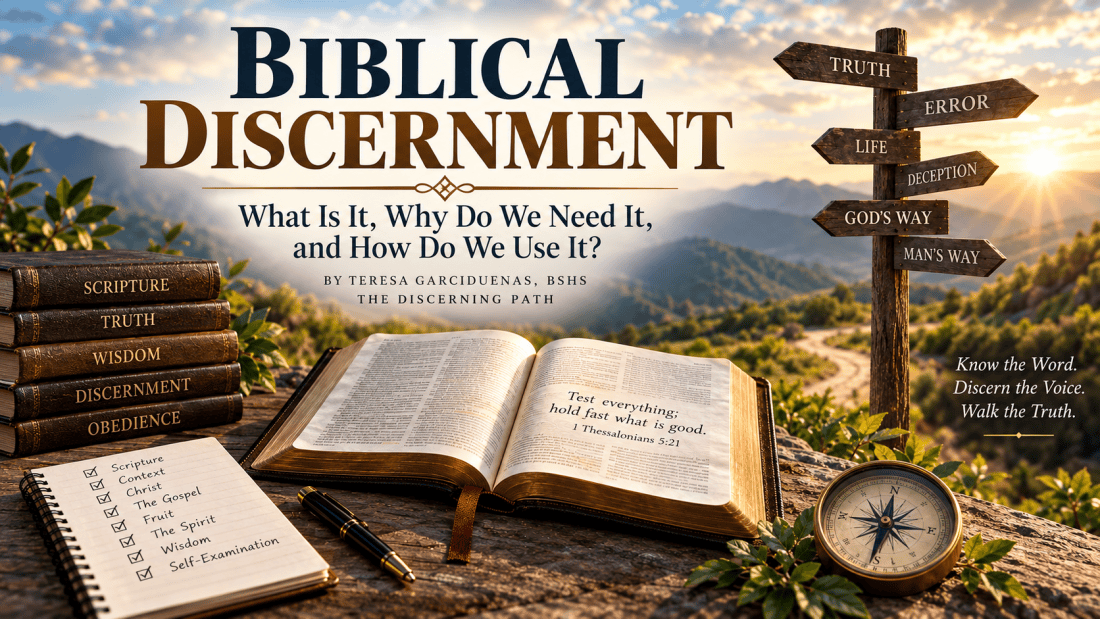
By Teresa Garciduenas, BSHS
The Discerning Path
We live in a world filled with competing voices. Pastors, teachers, authors, and social media personalities are claiming prophetic messages, dreams, visions, church traditions, personal revelations, and other theological interpretations—all claiming to represent truth.
For the Christian, however, the question cannot simply be, Does this sound spiritual? Nor can it be, Does this agree with the world’s cultural norms? The important questions are:
Is this true according to the Word of God? Is this scriptural?
Scripture does not instruct believers to accept every spiritual claim. Neither does it teach us to reject everything unfamiliar. Instead, the Bible repeatedly instructs God’s people to test, examine, distinguish, judge rightly, and hold fast to what is good.
“Test everything; hold fast what is good.”
— 1 Thessalonians 5:21, ESV
This is biblical discernment.
Biblical discernment can therefore be defined as the Spirit-enabled and Scripture-governed ability to examine what we hear, see, believe, and experience; distinguish truth from error, good from evil, and holy from profane; recognize what agrees with God’s revealed Word; and respond in wisdom and obedience.
But what does that look like in practice? Why does Scripture place so much emphasis on discernment? And how can Christians develop and use it?
Part One: What Is Biblical Discernment?
A Hearing Heart
One of the clearest Old Testament examples of discernment appears when Solomon asks God for wisdom:
“Give your servant therefore an understanding mind to govern your people, that I may discern between good and evil…”
— 1 Kings 3:9, ESV
The Hebrew behind “understanding mind” is especially significant. Solomon asks for a לֵב שֹׁמֵעַ (lev shomeaʿ), literally a hearing or listening heart.
The idea is more than intellectual knowledge. Solomon wants a heart capable of hearing rightly so that he can govern God’s people and distinguish between good and evil. The passage also uses language related to understanding or discerning, from the Hebrew root בִּין (bin), carrying the sense of understanding, perceiving, or distinguishing.
Biblical discernment, then, begins with a heart willing to listen to God and distinguish according to His truth.
This same principle appears throughout the wisdom literature. Proverbs tells us:
“For the LORD gives wisdom; from his mouth come knowledge and understanding.”
— Proverbs 2:6, ESV
And:
“The fear of the LORD is the beginning of wisdom, and the knowledge of the Holy One is insight.”
— Proverbs 9:10, ESV
The psalmist likewise connects understanding directly with God’s Word:
“Through your precepts I get understanding; therefore I hate every false way.”
— Psalm 119:104, ESV
“The unfolding of your words gives light; it imparts understanding to the simple.”
— Psalm 119:130, ESV
Biblical discernment is therefore not merely intuition. It is an understanding shaped by the revealed truth of God.
Discernment Distinguishes Good From Evil
Hebrews gives us another important description:
“But solid food is for the mature, for those who have their powers of discernment trained by constant practice to distinguish good from evil.”
— Hebrews 5:14, ESV
The Greek verb translated “trained” is γυμνάζω (gymnazō), which carries the idea of training, exercising, or disciplining.
The word translated “discernment” is related to διάκρισις (diakrisis), meaning a distinguishing or differentiation. Significantly, the same Greek noun appears in 1 Corinthians 12:10 in connection with the “distinguishing of spirits.”
Scripture does not portray discernment merely as something a person possesses automatically.
Discernment is trained.
The mature believer learns through continued exposure to God’s truth and by putting that truth into practice. Knowing Scripture is essential, but biblical discernment also requires learning how to understand and apply Scripture correctly.
The Transformation of the Mind Is Crucial
Paul writes:
“Do not be conformed to this world, but be transformed by the renewal of your mind, that by testing you may discern what is the will of God…”
— Romans 12:2, ESV
The transformation of the mind is crucial. Every culture and religion has oral traditions that have been handed down through generations. Over time, meanings, interpretations, and even details of stories can change. Every teacher also brings learned assumptions and biases to what they teach, just as each of us can view what we read through the lens of our own experiences.
Biblical discernment requires us to be willing to put those influences aside and allow God’s Word to examine our beliefs and reveal His truth.
Rather than asking Scripture to conform to what we have already been taught, what our culture accepts, or what we personally believe, we must be willing to allow Scripture to correct us.
This is why the renewal of the mind in Romans 12:2 is so important. Discernment requires more than examining the beliefs of others; it requires allowing the Word of God to examine our own beliefs as well.
The Greek verb used in Romans 12:2 is δοκιμάζω (dokimazō), which, depending on context, carries the idea of testing, examining, proving, or determining what is genuine or acceptable.
Paul uses related language in Philippians:
“And it is my prayer that your love may abound more and more, with knowledge and all discernment, so that you may approve what is excellent…”
— Philippians 1:9–10, ESV
Paul does not separate love, knowledge, and discernment. Biblical love does not require abandoning truth, and discernment does not require abandoning love.
Part Two: Why Do We Need Biblical Discernment?
The answer is fundamental:
Because deception does not always look like deception.
If every false teaching appeared obviously evil, very little discernment would be necessary. Scripture repeatedly warns believers precisely because error can appear convincing, spiritual, wise, biblical, compassionate, or even supernatural.
Therefore, Christians should be extremely careful about relying on human reasoning alone. In today’s society, we encounter influencers and religious personalities claiming to be prophets, faith healers, apostles, spiritual authorities, and recipients of dreams, visions, revelations, and messages from God.
Some of these claims may sound scriptural because they use biblical language, quote Scripture, or invoke the name of Jesus and the Holy Spirit.
But sounding biblical is not the same as being biblical.
This is precisely where discernment becomes necessary. A spiritual claim should not be accepted simply because it is persuasive, emotionally powerful, accompanied by an extraordinary experience, or presented by someone who appears sincere.
The question is not whether something appears spiritual. The question is whether it remains true when it is tested against the Word of God.
Not Every Spiritual Claim Comes From God
John gives Christians an explicit command:
“Beloved, do not believe every spirit, but test the spirits to see whether they are from God…”
— 1 John 4:1, ESV
John does not say, Believe every spirit.
But neither does he say, Reject everything spiritual.
He says:
Test the spirits.
Paul gives similar instructions:
“Do not quench the Spirit. Do not despise prophecies, but test everything; hold fast what is good.”
— 1 Thessalonians 5:19–21, ESV
Again, Scripture presents neither gullibility nor automatic rejection as the answer.
The answer is discernment.
A Supernatural Experience Is Not Its Own Proof
This principle appears even in the Old Testament.
Deuteronomy 13:1–5 warns Israel that even if a prophet or dreamer gives a sign and the sign occurs, the people must not follow that person into the worship of other gods.
That establishes an extremely important principle:
A supernatural sign does not have authority to overturn what God has already revealed.
Jesus likewise warned that false christs and false prophets would perform signs and wonders (Matthew 24:24). Paul also warns about false signs and wonders (2 Thessalonians 2:9–12).
Therefore, the Christian cannot simply reason:
Something supernatural happened; therefore, God must have done it.
The experience itself must be tested.
Even Scripture Can Be Misused
One of the clearest examples comes from the temptation of Jesus in Matthew 4.
Satan quoted Scripture. The words he quoted were not a lie; they came from the Word of God. The deception was in how he used them. Satan took Scripture and twisted its meaning in his favor, placing it into a new context through the way he framed his challenge to Jesus.
In Matthew 4:6, Satan quoted from Psalm 91:11–12:
“He will command his angels concerning you,” and “On their hands they will bear you up…”
— Matthew 4:6, ESV
The words themselves were Scripture, but Satan used them to tempt Jesus to put God to the test.
Jesus responded:
“Again it is written, ‘You shall not put the Lord your God to the test.’”
— Matthew 4:7, ESV; cf. Deuteronomy 6:16
Jesus did not deny the truth of Psalm 91. Instead, His response demonstrated that one passage of Scripture cannot rightly be interpreted in a way that contradicts another.
This gives us an important lesson in discernment. False teaching does not always require someone to deny Scripture outright. A person can quote an authentic biblical passage and still misuse it by changing its context, emphasizing one part while ignoring another, or framing it in such a way that it appears to support something the passage was never intended to teach.
Discernment is not merely checking whether a line of Scripture is in the Bible; it is examining whether Scripture is being handled faithfully in its proper context.
Therefore, the discerning Christian must ask more than:
Did they quote Scripture?
We must also ask:
Did they use Scripture correctly?
Who is speaking? Who is being addressed? What comes before and after the passage? Why was it written? How does the interpretation fit with the rest of Scripture?
As Paul instructed Timothy:
“Do your best to present yourself to God as one approved… rightly handling the word of truth.”
— 2 Timothy 2:15, ESV
Quoting Scripture and rightly handling Scripture are not necessarily the same thing.
The Bereans Give Us a Model
Acts 17 provides one of Scripture’s clearest examples of discernment:
“They received the word with all eagerness, examining the Scriptures daily to see if these things were so.”
— Acts 17:11, ESV
The Bereans listened eagerly to Paul, yet they still examined his teaching against Scripture.
That gives us an important principle:
No teacher should become more authoritative to us than the Word by which that teacher’s teaching must be tested.
Popularity cannot replace Scripture. Charisma cannot replace Scripture. A large following cannot replace Scripture. Academic credentials cannot replace Scripture. Tradition cannot replace Scripture. Personal revelation cannot replace Scripture. And our favorite teacher cannot replace Scripture.
Paul himself wrote:
“But even if we or an angel from heaven should preach to you a gospel contrary to the one we preached to you, let him be accursed.”
— Galatians 1:8, ESV
Truth is not determined by the status of the messenger.
False Teachers May Look Genuine
Jesus warned:
“Beware of false prophets, who come to you in sheep’s clothing but inwardly are ravenous wolves.”
— Matthew 7:15, ESV
Paul similarly warned:
“And no wonder, for even Satan disguises himself as an angel of light.”
— 2 Corinthians 11:14, ESV
Colossians warns about “plausible arguments” (Colossians 2:4) and “philosophy and empty deceit” (Colossians 2:8).
Sometimes the danger is not obvious evil.
Sometimes the danger is error dressed as truth.
Part Three: How Do We Use Biblical Discernment?
Scripture gives us several principles that can be applied when evaluating teachings, spiritual claims, traditions, experiences, and even our own beliefs.
1. The Scripture Test
The first question should be:
Does this agree with Scripture?
The Bereans examined Paul’s teaching against Scripture (Acts 17:11), while 2 Timothy 3:16–17 describes Scripture as God-breathed and useful for teaching, correction, and training in righteousness.
But this requires more than finding a verse that appears to support an idea.
The verse must be understood in context.
A biblical statement should be examined within its paragraph, chapter, book, historical setting, and ultimately the broader testimony of Scripture.
Discernment is not merely checking whether a line of Scripture is in the Bible; it is examining whether Scripture is being handled faithfully in its proper context.
2. The Christ Test
John connects the testing of spirits with what is confessed concerning Jesus Christ (1 John 4:1–3).
Second John 7–9 likewise warns against teaching that does not remain in the teaching of Christ.
Christ must remain central.
3. The Gospel Test
Paul gives an exceptionally strong warning in Galatians 1:6–9 against a distorted gospel.
When evaluating teaching, we should therefore ask whether it faithfully represents the biblical gospel.
What does it teach about sin? Grace? Faith? Repentance? Christ’s death and resurrection? Salvation? Does it add requirements Scripture does not add? Does it remove truths Scripture considers essential? Does it make Christ insufficient?
A message can use Christian vocabulary while communicating something fundamentally different from the biblical gospel.
4. The Fruit Test
Jesus said:
“You will recognize them by their fruits.”
— Matthew 7:16, ESV
Fruit matters.
Galatians 5:19–23 contrasts the works of the flesh with the fruit of the Spirit. James 3:13–18 contrasts earthly wisdom with wisdom from above.
We should therefore examine not merely what a teaching promises but what it consistently produces.
Does it encourage holiness, truth, humility, love, repentance, obedience, and Christlikeness?
Or does it consistently produce greed, manipulation, pride, sensuality, division, fear, or obsession with the teacher?
Fruit does not replace doctrinal testing, but Scripture tells us not to ignore it.
5. The Spirit Test
Scripture specifically commands believers to test spiritual claims.
Relevant passages include Deuteronomy 13:1–5; 1 Corinthians 12:10; 14:29; 1 Thessalonians 5:19–22; and 1 John 4:1–6.
Paul specifically instructs the church regarding prophetic speech:
“Let two or three prophets speak, and let the others weigh what is said.”
— 1 Corinthians 14:29, ESV
A claim to speak prophetically did not remove the responsibility to evaluate what was said.
Claiming that something came from the Holy Spirit does not exempt that claim from biblical examination. If a claim is attributed to God, there is all the more reason to test it carefully.
Distinguishing of Spirits
First Corinthians 12:10 lists “the ability to distinguish between spirits” among the manifestations of the Holy Spirit. This particular gift should be handled carefully and understood within the larger teaching of Scripture.
Scripture presents the spiritual realm as a reality and speaks of both angels who serve God and spiritual beings who oppose Him (Psalm 103:20; Daniel 10:12–13; Matthew 25:41; Ephesians 6:12; Revelation 12:7–9).
John therefore warns:
“Beloved, do not believe every spirit, but test the spirits to see whether they are from God…”
— 1 John 4:1, ESV
The command to test the spirits itself tells us something important:
Not every spirit is from God.
Acts provides a particularly instructive example. A slave girl following Paul and Silas is described as having “a spirit of divination” (Acts 16:16). She publicly identified Paul and his companions as servants of the Most High God who proclaimed a way of salvation. Yet Paul ultimately commanded the spirit to leave her in the name of Jesus Christ (Acts 16:16–18).
This provides another important lesson in discernment: the presence of a true statement does not, by itself, establish that its spiritual source is from God.
At the same time, the biblical gift of distinguishing spirits should never be confused with occult practices or attempts to obtain hidden spiritual knowledge.
Scripture repeatedly condemns divination, sorcery, mediums, necromancy, and attempts to consult the dead (Leviticus 19:31; 20:6; Deuteronomy 18:9–14; Isaiah 8:19–20). First Samuel 28 also records Saul’s disastrous decision to seek out the medium at Endor after he had already departed from obedience to God.
God does not instruct His people to seek Him through spirit boards, divination cards, mediums, or communication with deceased relatives. These practices are not examples of the biblical gift of distinguishing spirits. They are practices from which Scripture specifically tells God’s people to separate themselves from.
Nor should spiritual gifts be treated as a means of obtaining secret knowledge that makes one Christian spiritually superior to another.
Paul writes:
“Now there are varieties of gifts, but the same Spirit…”
— 1 Corinthians 12:4, ESV
And:
“All these are empowered by one and the same Spirit, who apportions to each one individually as he wills.”
— 1 Corinthians 12:11, ESV
No spiritual gift gives its recipient a superior spiritual status over the rest of the body of Christ. Paul’s larger argument is that believers have different functions within one body, and the members need one another (1 Corinthians 12:12–27).
This is consistent with the biblical principle that “God shows no partiality” (Romans 2:11; cf. Acts 10:34). Different gifts should not be interpreted as God valuing one believer more highly than another.
Distinguishing of spirits is not communicating with spirits. It is discerning their source.
Biblical discernment does not require Christians to identify, name, classify, or communicate with spirits. Scripture calls believers to test spiritual claims and resist evil; this is very different from attempting to obtain hidden information from the spiritual realm.
The Christian’s source of truth is not an unseen spirit, a medium, divination, or an occult practice, but God and His revealed Word (Deuteronomy 18:9–14; Isaiah 8:19–20; 1 John 4:1–6).
When someone claims special revelation, a prophetic message, a supernatural encounter, or knowledge supposedly received from a spiritual source, the Christian response should not be automatic belief—or automatic disbelief.
It should be:
Test it.
6. The Wisdom Test
James tells believers:
“If any of you lacks wisdom, let him ask God…”
— James 1:5, ESV
James later describes wisdom from above as pure, peaceable, gentle, open to reason, full of mercy and good fruits, impartial, and sincere (James 3:17).
Biblical discernment therefore asks not merely:
Can this be done?
It also asks:
Is this wise? Is it righteous? Is it consistent with the character and revealed will of God?
7. The Self-Examination Test
Perhaps one of the most neglected aspects of discernment is examining ourselves.
The psalmist prayed:
“Search me, O God, and know my heart! Try me and know my thoughts!”
— Psalm 139:23, ESV
Scripture repeatedly reinforces this principle (Lamentations 3:40; 1 Corinthians 11:28; 2 Corinthians 13:5; James 1:22–25).
We can become very skilled at finding error in someone else while remaining blind to our own assumptions.
This brings us back to the renewal of the mind.
Our upbringing, denomination, culture, traditions, teachers, personal experiences, disappointments, expectations, and preferences can influence the way we approach Scripture.
Therefore, biblical discernment must begin with humility.
Scripture is not merely a telescope through which we examine everyone else. It is also a mirror through which God examines us.
Discernment Is Not the Same as Being Judgmental
One objection frequently raised when Christians discuss discernment is Jesus’ command:
“Judge not, that you be not judged.”
— Matthew 7:1, ESV
But the surrounding passage shows that Jesus is addressing hypocritical judgment. He describes a person attempting to remove a speck from another person’s eye while ignoring the log in his own.
Jesus does not conclude that the speck should never be addressed. He commands the person first to remove the log from his own eye so that he can see clearly (Matthew 7:3–5).
Elsewhere Jesus says:
“Do not judge by appearances, but judge with right judgment.”
— John 7:24, ESV
Scripture therefore distinguishes between self-righteous condemnation and righteous evaluation.
Biblical discernment requires humility precisely because we ourselves remain capable of error.
Discernment Is Not Suspicion
Discernment can also become confused with cynicism.
A suspicious person may begin by assuming something is false and then search for evidence confirming that assumption.
A discerning person asks:
What is true?
Biblical discernment does not mean believing everyone is lying. It does not require seeing hidden evil behind everything unfamiliar. It does not give us permission to treat personal preferences as divine commands. Nor does it make the discerning person spiritually superior to everyone else.
Biblical discernment is not about becoming harder to convince. It is about becoming better able to recognize truth.
Discernment Must Be Trained
Hebrews 5:14 brings us back to where we began: mature believers have their powers of discernment “trained by constant practice to distinguish good from evil.”
Discernment grows through practice.
We train discernment by studying Scripture carefully, reading passages in context, praying for wisdom, testing teaching, comparing interpretations with the whole counsel of Scripture, examining fruit, accepting correction, and being willing to abandon an interpretation when Scripture demonstrates that we are wrong.
That final point is essential.
Discernment is not the ability to prove ourselves right. It includes the willingness to discover when we are wrong.
If Scripture is truly our authority, then we must permit Scripture to correct not only everyone else—but us.
The Discerning Path
From Genesis to Revelation, Scripture repeatedly calls God’s people to distinguish truth from error.
Solomon asks for discernment between good and evil (1 Kings 3:9). The psalmist receives understanding through God’s precepts (Psalm 119:104–105, 130). Jesus commands His followers to recognize false prophets by their fruit (Matthew 7:15–20). The Bereans examine teaching against Scripture (Acts 17:11). Paul tells believers to renew their minds so they can discern God’s will (Romans 12:2). Prophetic messages are to be evaluated (1 Corinthians 14:29). Christians are commanded to test everything and hold fast to what is good (1 Thessalonians 5:21). Spiritual maturity trains the senses to distinguish good from evil (Hebrews 5:14). James tells believers to ask God for wisdom (James 1:5). John commands Christians to test the spirits (1 John 4:1).
Taken together, these passages reveal something important:
Discernment is not an optional activity reserved for theologians, pastors, or scholars. It is part of mature Christian discipleship.
Conclusion
Biblical discernment is necessary because Christians live in a world of competing voices. Some are openly opposed to Scripture, while others may sound Christian, spiritual, prophetic, compassionate, or even quote the Bible itself.
The answer is not fear, suspicion, or automatic rejection.
Neither is it unquestioning acceptance.
The answer is biblical discernment.
Biblical discernment is the Spirit-enabled and Scripture-governed ability to distinguish truth from error, good from evil, and what comes from God from what does not.
It requires us to know Scripture—but also to know Scripture in context. Satan’s temptation of Jesus demonstrates that biblical words can be quoted while their meaning is being misused. Therefore, discernment is not merely checking whether a line of Scripture is in the Bible; it is examining whether Scripture is being handled faithfully in its proper context.
Discernment also requires humility.
We must be willing to examine our traditions, our teachers, our experiences, our assumptions, and even our own interpretations. If we are willing to use Scripture to correct everyone except ourselves, we have missed an essential part of biblical discernment.
We must also test spiritual claims. Scripture acknowledges the reality of the spiritual realm while warning us that not every spirit is from God. Christians are not instructed to seek secret knowledge through spirits, mediums, divination, or communication with the dead. We are instructed to test spiritual claims according to the truth God has revealed.
We examine doctrine.
We examine context.
We examine fruit.
We test spiritual claims.
We seek wisdom.
And we examine ourselves.
Biblical discernment is not the ability to prove ourselves right. It is the willingness to pursue what is true—even when the truth requires us to change what we previously believed.
God’s Word, not culture, popularity, tradition, charisma, personal experience, or spiritual appearance, remains the standard.
Paul’s instruction is remarkably simple:
“Test everything; hold fast what is good.”
— 1 Thessalonians 5:21, ESV
That is the discerning path.
Scripture References for Further Study
Old Testament: Leviticus 19:31; 20:6; Deuteronomy 6:16; 13:1–5; 18:9–22; 1 Samuel 28:3–25; 1 Kings 3:9–12; Psalm 19:7–11; 103:20; 119:66, 98–105, 125, 130, 160; Proverbs 2:1–11; 3:13–18; 9:10; 14:8, 15; 18:15; Isaiah 5:20–21; 8:19–20; Jeremiah 23:16–32; Ezekiel 22:26; 44:23; Daniel 10:12–13; Malachi 3:18.
New Testament: Matthew 4:1–11; 7:1–23; 12:33–37; 24:4–5, 11, 23–26; 25:41; Luke 6:43–45; John 7:24; Acts 10:34; 16:16–18; 17:10–12; Romans 2:11; 12:1–2; 16:17–18; 1 Corinthians 2:10–16; 5:9–13; 10:15; 12:4–27; 14:29; 2 Corinthians 11:3–15; 13:5; Galatians 1:6–9; 5:19–23; Ephesians 4:11–14; 5:6–17; 6:10–18; Colossians 1:9–10; 2:4–8; 1 Thessalonians 5:19–22; 2 Thessalonians 2:9–12; 1 Timothy 4:1; 2 Timothy 2:15; 3:13–17; 4:3–4; Hebrews 4:12; 5:11–14; James 1:5, 22–25; 3:13–18; 1 John 4:1–6; 2 John 7–11; Jude 3–4; Revelation 2:2; 12:7–9.
Notes and Resources
For the Hebrew discussion of 1 Kings 3:9, useful lexical resources include Francis Brown, S. R. Driver, and Charles A. Briggs, A Hebrew and English Lexicon of the Old Testament (BDB), and Ludwig Koehler, Walter Baumgartner, and Johann Jakob Stamm, The Hebrew and Aramaic Lexicon of the Old Testament (HALOT).
For the Greek terminology used in Romans 12:2, 1 Corinthians 12:10, and Hebrews 5:14, useful lexical resources include Walter Bauer, Frederick W. Danker, William F. Arndt, and F. Wilbur Gingrich, A Greek-English Lexicon of the New Testament and Other Early Christian Literature, 3rd ed. (BDAG), and Johannes P. Louw and Eugene A. Nida, Greek-English Lexicon of the New Testament Based on Semantic Domains, 2nd ed.
For primary-language study, consult the Biblia Hebraica Stuttgartensia/Biblia Hebraica Quinta for the Hebrew Bible and the Nestle-Aland Novum Testamentum Graece, 28th edition (NA28) for the Greek New Testament.
Word-study note: Hebrew and Greek words often have a range of possible meanings. Every dictionary definition does not apply to every occurrence. Meaning must be determined by grammar, immediate context, authorial usage, and the broader biblical setting. This principle is itself important to biblical discernment: word studies should illuminate the biblical text, not be used to make the text say something its context does not support.

